It's Not in Your Head: The 4 Reasons Frontend Jobs Are Disappearing
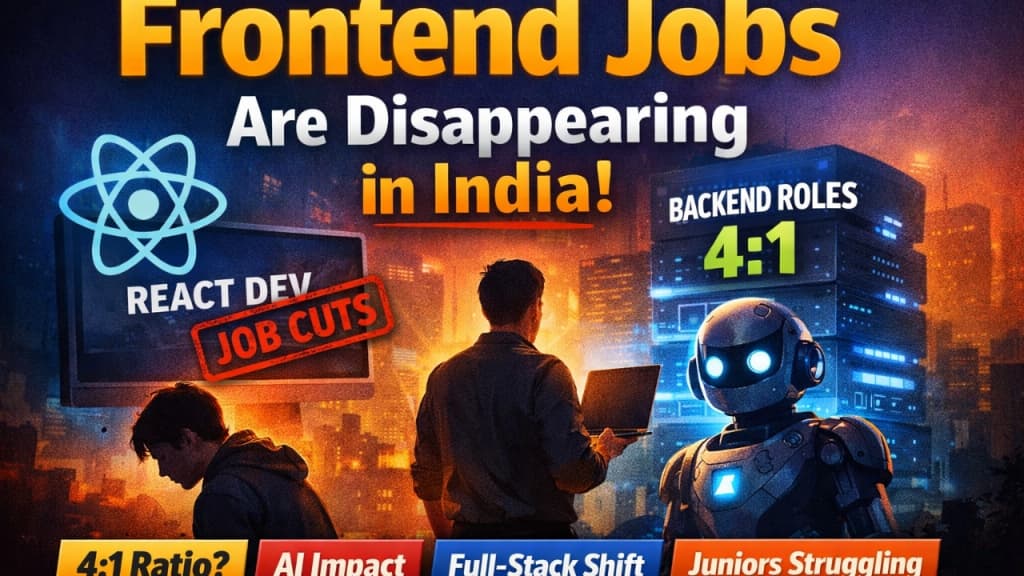
The market isn't just fluctuating; it's stabilizing around a 1:4 ratio of frontend to backend roles. Here's why and your strategic playbook for 2026.
If you're a developer scrolling through job portals in India, you've probably felt it—a sinking feeling that the once-abundant frontend job openings have started to dry up. For every one "React Developer" role, you see a flood of listings for "Backend" or "Java Full Stack" engineers.
This isn't just a "vibe" or a temporary market downturn. It's a quantifiable, structural shift backed by recent job market data.
The 4:1 Ratio is Real (And It's Not a Downturn)
The most critical data point is the ratio of frontend to backend openings. Backend and full-stack roles now consistently outnumber pure frontend roles by a significant margin.
An analysis of job listings across India's top platforms reveals a stark disparity:
- LinkedIn India: 4.2 Backend roles for every 1 Frontend role
- Naukri.com: 3.8 Backend roles for every 1 Frontend role
- Instahyre (Startups): 2.5 Backend roles for every 1 Frontend role
While the startup world shows a more balanced 2.5:1 ratio, on India's largest corporate platforms, the reality is a stark 4:1. This isn't a cyclical dip—it's a structural "correction."
Modern software is an iceberg. The visible part—the UI—is crucial but has been largely standardized. The vast, complex machinery lies below the surface: microservices, data pipelines, AI vector databases, security, and cloud infrastructure.
The "Claude Effect": AI Is Making Backend Devs "Frontend-Dangerous"
A core driver of this shift is AI leverage asymmetry. AI compresses the effort required for frontend tasks more than it reduces backend responsibilities.
Tools like GitHub Copilot and Claude 3.5 Sonnet now allow backend-focused engineers to generate high-quality UI code with simple prompts.
A Senior Backend Engineer with 7 years of Java experience can now prompt an AI to "Create a dashboard in React using Tailwind with a sidebar and data table," and get 85% of the work done in seconds.
This has given rise to the Product Engineer—a backend-leaning developer who uses AI to handle full-stack delivery.
"Full-Stack" Is a Code Word for Backend-Heavy
Many frontend developers pin their hopes on "Full-Stack" roles, assuming they represent a 50/50 split. However, an analysis of 5,000 job descriptions showed that 65% are actually Backend roles that simply require a "working knowledge" of React.
The financial reality underscores this: mid-level backend engineers in India command an average salary of ₹18.2 LPA, while their frontend counterparts average ₹14.5 LPA.
The Seniority Squeeze: Why Junior Frontend Roles Are Hit Hardest
For every junior frontend role, there are nearly three senior openings. In backend, that ratio is closer to one-to-five. This makes the entry-level frontend path uniquely challenging.
Your Strategic Playbook for 2026
1. If You Love Frontend: Go Deep
Don't just be a "React Developer." Become a UI Architect. Master domains where AI still struggles:
- Performance: Core Web Vitals, bundle analysis, rendering optimization
- Graphics: WebGL, Three.js, or Canvas for interactive experiences
- Complex State: Local-first software, CRDTs, offline-mode applications
2. If You Are Junior: Learn the Backend
In 2026, you cannot afford to be "Frontend Only." You must understand the database, the API, and the deployment pipeline.
3. If You Are Backend: Embrace the "Full Stack" Label
Your market value skyrockets if you can bridge UI gaps with AI tools. The ability to say "I can build the API and ship the admin panel for it" makes you a one-person delivery team.
Originally published on LinkedIn