Zustand vs Redux Toolkit: Which Should You Use in 2026?
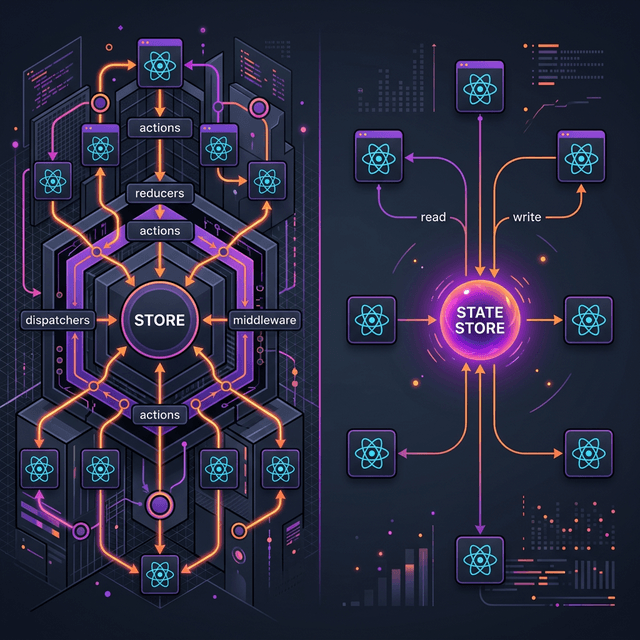
A complete architectural breakdown of Zustand vs Redux Toolkit (RTK) for React and Next.js applications. Learn when to use which state manager for your next FAANG interview.
If you are building a modern React or Next.js application in 2026, or if you're preparing for a Senior Frontend Interview, you will inevitably be asked about state management.
The days of raw Context API and messy prop-drilling are over. Today, the conversation is almost exclusively a two-horse race: Zustand vs. Redux Toolkit (RTK).
But which one should you choose? And more importantly, how do you justify your choice to a hiring committee at Google or Amazon?
Let's break down the architectural differences, boilerplate footprint, and ideal use cases for both.
1. Zustand: The Bear Minimum
Zustand (German for "state") took the React ecosystem by storm because it actively mocks the traditional complexity of Redux. It is built around a single, unopinionated hook.
How it works
You create a custom hook that holds both your state and the actions that mutate that state.
import { create } from 'zustand';

const useStore = create((set) => ({
  bears: 0,
  increasePopulation: () => set((state) => ({ bears: state.bears + 1 })),
  removeAllBears: () => set({ bears: 0 }),
}));
The Pros:
- Zero Boilerplate: No Context Providers wrapping your app. No dispatchers. No complex reducers.
- Performance: Zustand allows components to selectively subscribe to specific slices of state. If a component only cares about
state.bears, it won't re-render ifstate.foxeschanges. - Async Native: You don't need middle-ware like Redux Thunk or Saga. Just use
async/awaitdirectly inside your actions.
The Cons:
- Too Unopinionated: For very large enterprise teams, the lack of strict structure can lead to messy, disorganized store files if developers aren't disciplined.
2. Redux Toolkit (RTK): The Enterprise Standard
Redux used to be famous for requiring a PhD in boilerplate to set up. Redux Toolkit (RTK) was created to fix that, acting as the official, opinionated, "batteries-included" toolset for Redux.
How it works
RTK uses "Slices" to automatically generate action creators and action types based on your reducers.
import { createSlice, configureStore } from '@reduxjs/toolkit';

const counterSlice = createSlice({
  name: 'counter',
  initialState: { value: 0 },
  reducers: {
    increment: (state) => {
      // Redux Toolkit allows us to write "mutating" logic in reducers using Immer
      state.value += 1;
    },
  },
});

export const store = configureStore({
  reducer: counterSlice.reducer,
});
The Pros:
- The DevTools are God-Tier: Redux DevTools offer time-travel debugging and incredible visibility into every single state mutation. Zustand has DevTools integration, but RTK is built around it.
- Strict Architecture: It forces your team into a predictable pattern. In massive codebases (like those you’d find in Meta Frontend Interviews), this predictability is a feature, not a bug.
- RTK Query: This is Redux Toolkit's secret weapon. It is a powerful data fetching and caching tool (similar to React Query) built right into the ecosystem.
The Cons:
- Bundle Size: RTK is significantly heavier than Zustand.
- Overhead: You still need a
<Provider>at the root of your app, and dispatching actions still feels "heavier" than simply calling a Zustand function.
The Interview Answer: Which Should You Use?
In a system design interview, "it depends" is the only correct answer.
Use Zustand if:
- You are building a fast, lightweight dashboard, a side-project, or a highly interactive widget where rendering performance and developer velocity are your top priorities.
- You are using React Query or SWR for managing your server state, and you only need a tool to manage localized UI state (like dark mode toggles or complex multi-step forms).
Use Redux Toolkit if:
- You are architecting a massive enterprise application with dozens of engineers contributing to the same codebase.
- You absolutely require complex time-travel debugging or rigorous audit trails of every user interaction.
- You want to leverage RTK Query for both state management and data fetching in one unified system.
Prepare for the Follow-Up
If you confidently answer this question, be prepared for the interviewer to dig deeper. They might ask, "How does Zustand achieve selective re-rendering without Context?" (Answer: It uses the publisher-subscriber pattern and React's useSyncExternalStore hook).
To see how companies are testing state management in 2026, check out the latest React Interview Experiences from top tech companies!